Why Is B2B SEO Different from B2C SEO? (And Why It Matters)
For many businesses, SEO is just one set of rules: optimize keywords, build backlinks, and write great content. While this foundation is necessary for any business who wants to grow organically, create brand visibility on search engines and achieve authority, this simple approach stops working when you try to sell to another business (B2B) instead of a single person (B2C).
Treating B2B SEO the same as B2C SEO is a guaranteed path to inefficient spending, attracting audiences with no purchase intent, and overlooking key opportunities for growth. The core reason? The fundamental nature of the transaction changes entirely, and your strategy must change with it.
What Is B2B SEO?
B2B SEO (Business-to-Business SEO) is a strategy that helps B2B websites rank on search engines when other businesses are searching for the services, software, or products you offer.
Unlike B2C SEO Service, the goal is not to drive general traffic volume; it’s to attract professionals who are ready to make a serious business purchase—people who have the authority and the budget to make a significant purchase.
The Difference Between B2B SEO and B2C SEO
Understanding the difference starts with realizing that the entire goal of your marketing changes. Below is a simple breakdown of the core strategic differences:
| Feature | B2C SEO (Normal SEO) | B2B SEO |
| Audience | Emotional, impulsive, seeking immediate gratification or personal benefit. | Professional, rational, seeking an ROI-driven solution for a business problem. |
| Search Intent | Transactional/Product-Oriented: “Buy blue running shoes,” “Best cheap headphones.” | Informational/Solution-Oriented: “Best enterprise CRM software,” “How to reduce SaaS churn.” |
| Keywords | Short-tail, high search volume, general terms (e.g.,”best deals,” “cheap”) Focus is on volume and quick sales. | Long-tail, niche specific, solution-focused, lower search volume but high commercial intent (e.g.,”HR software for 50+ employees”). Focus is on quality leads, not mass traffic. |
| Buying Motivation | Emotion, impulse, wanting something fast. | Logic, facts, and focused on getting a return on investment (ROI). |
| Conversion Goal | Getting an immediate sale (“Buy Now”). | Getting a qualified lead (“Book a Demo” or “Request a Price”). |
| Key Metric | Total website traffic and final sales. | Number of qualified leads and how fast a lead moves toward a sale. |
How Dedicated B2B SEO Drives Qualified Leads and Real Business Growth
SEO must go beyond simple keyword matching to become a precise growth engine in the fiercely competitive SaaS and AI industries. Instead of only focusing on high search volume, dedicated B2B SEO aims to draw in an audience with strong buying intent. This entails focusing on specialized, problem-specific phrases that technical teams and decision-makers use for platforms that leverage complicated or developing technologies like AI, such as “LLM security policy” or “AI-driven demand forecasting software”.
This approach requires in-depth whitepapers, technical documentation, and customer success stories that attest to the platform’s long-term commercial value and integration possibilities. By mapping content to every step of the business buyer’s research journey, from initial problem awareness to final vendor comparison, B2B SEO ensures your SaaS solution appears at the critical point of evaluation, converting casual visitors into Sales Qualified Leads (SQLs) and drives steady, sustainable revenue growth.
Due to the fact that decisions are made from the team’s initial study to the final purchase, the B2B purchasing process is inherently complicated. Because of this procedure, B2B buyers take a lot longer than typical B2C buyers. Let’s examine purchasing decisions in more detail below:
Why B2B Buyers Take More Time
The long sales cycle in B2B is the biggest difference and directly shapes your SEO content strategy. While a typical B2C purchase may happen within minutes, a B2B purchase is a major investment that impacts a company’s finances, efficiency, and personnel. The decision-making process involves:
- Multiple Stakeholders: The end-user, the budget approver (CFO), and the IT security team may all need to approve.
- Deep Research: Buyers compare various options, evaluate complex feature sets, and look closely at the cost.
- Reducing Risk: B2B buyers prioritize risk avoidance. They require concrete evidence—like case studies and verifiable testimonials—that your solution works for similar businesses.
Why this matters for SEO: Because the decision takes time, your content must guide the buyer through every stage of their research, from initial research to the final decision.
Business-Focused Keywords in B2B SEO
In B2C SEO, you target short-tail, high-volume keywords like “best running shoes.” In B2B SEO, the focus shifts entirely to long-tail, intent-driven phrases that capture the specific business problem.
For example, a generic search for “CRM software” is too broad, but high-intent B2B keywords are focused on finding the right solution:
- “CRM for small businesses”
- “IT support company for financial compliance”
- “Cloud infrastructure migration service costs”
- “Enterprise accounting software comparison”
These keywords may have lower search volume, but they attract searchers who are much more qualified and closer to making a purchase. In B2B SEO, a few hundred qualified visitors are more valuable than ten thousand unqualified ones.
B2B SEO Conversion Goals (Lead Generation vs. Sale)
In B2C SEO, conversion is just the sale. In B2B, the goal is to secure an opportunity to start a relationship with a qualified potential client, not the sale itself.
The conversion goals shift from immediate purchase to lead generation:
- From: Buy Now
- To: Book a Demo, Request a Quote, or Talk to a Specialist.
Thus, B2B websites are optimized to collect contact information. Effective B2B SEO focuses on high-quality lead forms, offering valuable content (like whitepapers) in exchange for an email, and using clear Calls-to-Action (CTAs) that direct visitors to the sales team.
B2B Content Strategy for the Buyer’s Journey (TOFU, MOFU, BOFU)
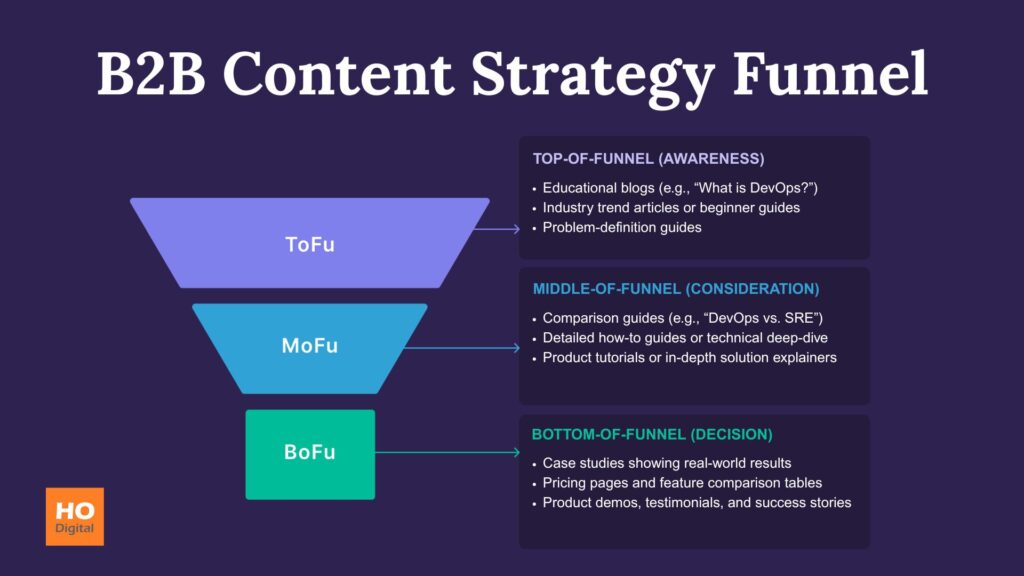
To win the logical, risk-averse B2B buyer, your content must prove you have authority and expertise at every stage.
The content B2B buyers actively search for includes:
- Top-of-Funnel (Awareness): Educational blog posts that define a problem (e.g., “What is DevOps?”).
- Middle-of-Funnel (Consideration): In-depth comparisons, guides, and technical specifications (e.g., “DevOps vs. SRE: A Full Comparison”).
- Bottom-of-Funnel (Decision): Case studies that show real-world results, detailed pricing information, and clear product feature breakdowns.
Final Thoughts
In short, the key takeaway is clear: B2B SEO is not just a tougher version of B2C SEO; it’s a distinct approach. You’re delivering a long-term, critical business solution, not a consumer product. This requires patience, targeting different keywords, and content that educates and builds deep trust.
If you’re a business in or around Gurgaon and you want to move beyond generic site traffic to generate high-quality, long-term leads that turn into revenue, you need an expert strategy designed for the B2B journey. That’s exactly what we, at HO Digital, specialize in—turning your website into a powerful, measurable, and highly effective lead-generating asset for your business.